


User Experience
Conformity Bias: How Marketers use Social Trends to their Advantage
We change our behavior according to what is socially accepted at the moment. Here, we will go into detail how marketers use conformity bias.
Page 6 of 7. Articles 61 to 72 of 81, newest first. Pick a topic in the bar above to narrow down.
We change our behavior according to what is socially accepted at the moment. Here, we will go into detail how marketers use conformity bias.

In this article, we are going to look at one of the cognitive biases: framing and how we can frame content to influence decision making.

Figure-ground is how we separate a subject from its background. What it is, ambiguous examples like Rubin's vase, and how designers use it in logos and UI.

Chunking breaks information into memorable groups. Where the idea comes from, why 7 plus or minus 2 is misread, and how to chunk content in interfaces.
The law of proximity: things placed close together are read as a group. Proximity vs similarity, and how spacing alone can organise a layout. Examples included.
Legibility is whether you can recognise letters. Readability is whether you want to keep reading. What each means, what affects it, and how to improve both.

Why do realistic robots, mannequins and CG characters feel unsettling? An introduction to the uncanny valley, Mori's graph and what it means for design.
The law of common fate says elements moving together are perceived as a group. What it is and how motion, animation and interaction design put it to work.
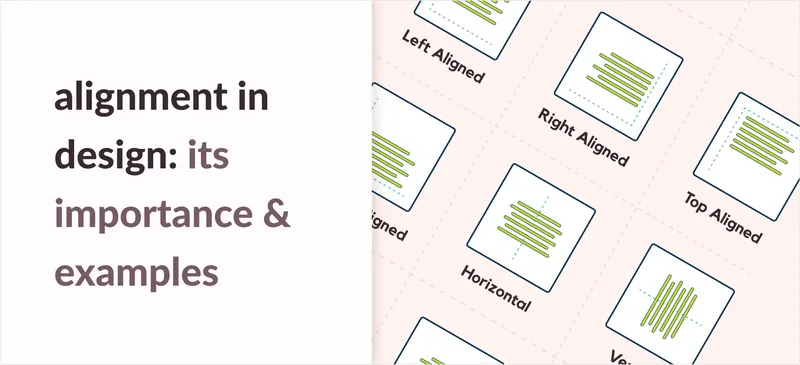
Alignment is the simplest principle of good layout. The types of alignment, why edge alignment beats centering, real interface examples and a free PDF.
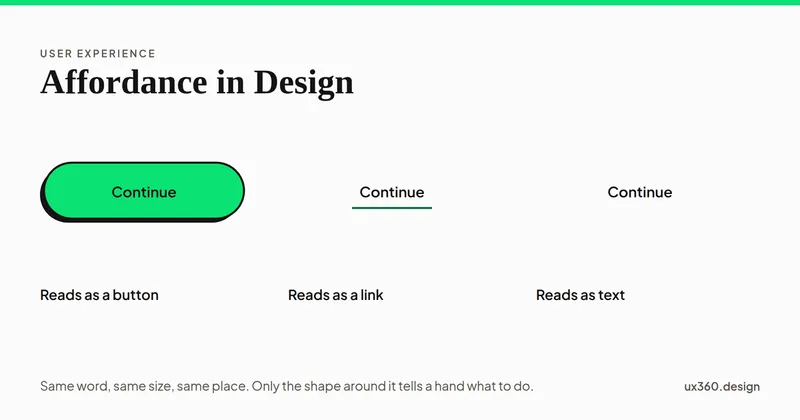
Affordance means an object's physical properties suggest how it is used. What it is, why it makes products efficient, and how to apply it in UI design.

Accessible design lets anyone use a product fully. Learn the four traits (perceivable, operable, simple, forgiving) with examples from Fortnite and Xbox.
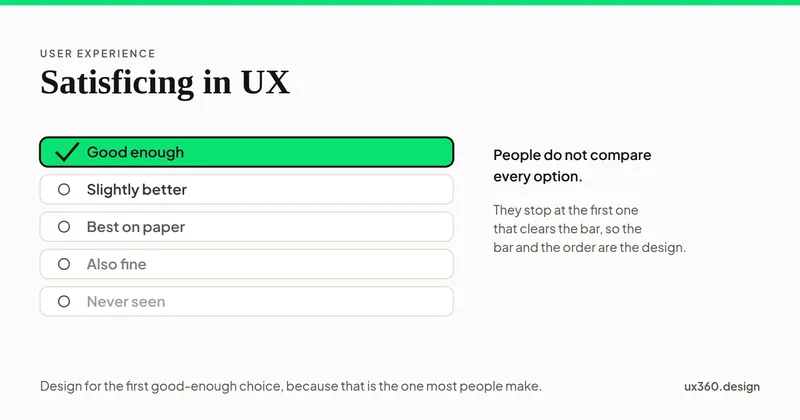
Satisficing is a decision-making behavior where users settle for a satisfactory solution instead of a better solution which would require more effort.