
Satisficing in UX: Prioritizing Satisfactory Solution over an Optimal Solution
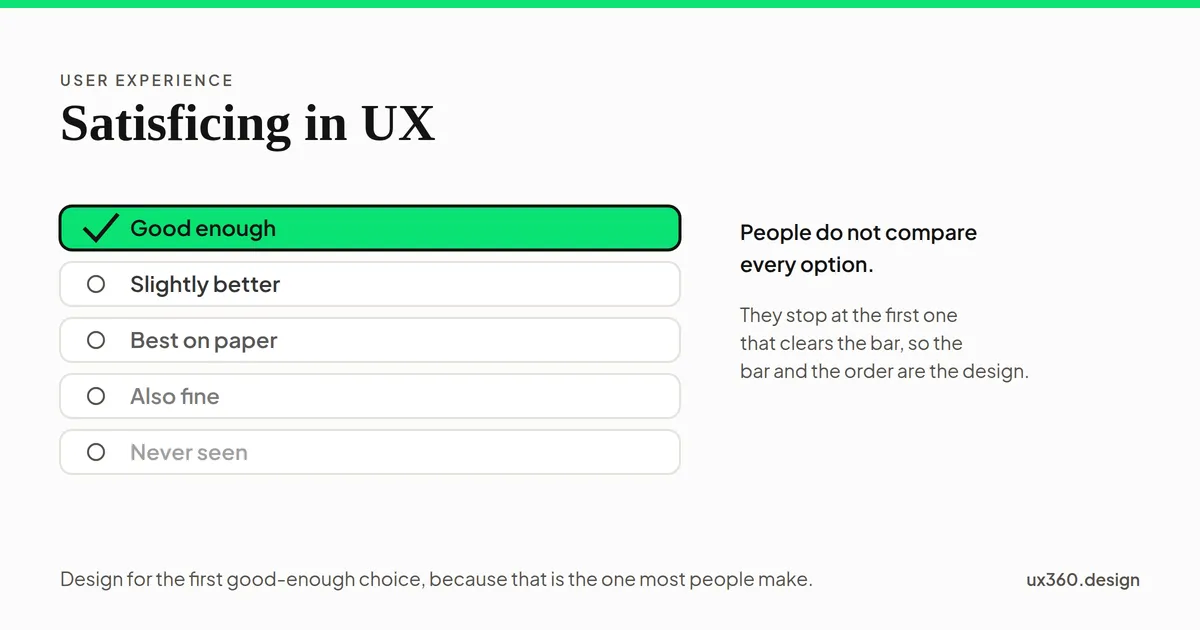
Satisficing is a decision making behaviour where people settle for a satisfactory answer rather than the better one that would cost more effort. Herbert Simon coined it from satisfy and suffice. It is why readers scan headings instead of reading, and why an interface has to make the good enough path the obvious one.
What is satisficing?
Satisficing is a decision-making behavior where users settle for a satisfactory solution instead of a better solution which would require more effort.
For example, when we read articles, we scan through headlines and points to understand the gist of the complete article. This is because users tend to put minimal effort to get a solution than to invest a lot more time.
Some things to know:
- Satisficing is also known as Best is the enemy of the good principle.
- Satisficing was first coined by psychologist Herbert A. Simon combining words “satisfy” and “suffice”.
- People who subconsciously show this particular behavior is termed as Satisficers.
Satisficing and Product Design
When creating a product, we generally want to include every important detail for the people. But on some occasions, we could provide a satisficing product.
For example, in the early stages of product development, it is important to find the product-market fit, i.e. if a product is something that people want, we would want to push our product as soon as possible to test the market.
Since we are constrained by time and only testing the market, we can create a product with bare minimum features. We might trade-off aesthetics or good-to-have features for the most essential features. The essential features being the solution to the specific problem.
Designing for Satisficers
To use satisficing to our advantage, we need to know how we can design for satisficers.
Always create an easy to use interface.
We should never make users think too much about their next steps. This helps their interaction with the product less frustrating, consequently, reaching their goals faster. For example, an image compression website doesn’t need users to sign up to compress their images. A well-placed upload button will suffice.
Provide useful information immediately.
We should not add unnecessary information making it difficult for users to find the actual information. User intent is important, so always add a proper heading, segments, bullet points, and highlights.
For Example, Amazon’s sorting and filtering are useful features for users to find products quickly.
Create a good navigation system.
A good navigating system makes it easier for users to find what they are looking for. For mobile apps, it is best to keep the top 5 features on the bottom navigation. For web pages, navigation in headers is the most common way to go.
Optimizations for Content Writing
Breaking down long articles into short paragraphs and points for easy scanning. It is important to keep your paragraphs short and important knowledge of points. Key Takeaways, TLDR; in long articles helps to summarize the article and provide important information.
News websites’ headings and article structure are a great example. They provide the most important information in their headings.
Summing Up
- Satisficing is a user behavior where they tend to be satisfied with a quick solution rather than an optimal solution.
- Satisficing can be used to our advantage by distributing resources.
- Always put out important information first. This should be our top priority.
Further Reading:
Frequently asked questions
What is satisficing?
Satisficing is settling for a satisfactory solution instead of a better one that would take more effort to reach. It is also known as the best is the enemy of the good principle.
Why do users satisfice?
Because effort is a real cost. People scan headlines and bullet points to get the gist of an article rather than read it, since the gist is usually enough for what they came to do.
How do you design for satisficers?
Keep the interface easy to use, put the useful information in front of people immediately rather than a level down, build navigation that does not need to be learned, and write content that can be scanned.
From UI to UX: a free one-week course
Become the person in the room who understands the user when everyone else is guessing. Six free lessons, no sign-up.

Written by