
Hindsight Bias in UX: Why Research Findings Feel Obvious Afterwards
Hindsight bias is the feeling, once you know how something turned out, that you saw it coming. In UX it makes research findings look obvious, so teams think they learned nothing and stop testing. The fix is to write down what you expect before you see the results.
What is hindsight bias? Hindsight bias is the feeling, once you know how something turned out, that you saw it coming.
Before a test, the answer could go many ways. After it, only one way seems possible. You do not just learn the answer. You start to remember having known it.
In short
- What it is: a bias where knowing the outcome makes it seem obvious, and makes you think you predicted it.
- Why it matters: research findings start to look like common sense, so the team decides it learned nothing.
- How it shows up: “We knew that already.” “That was obvious.” “I said so in the kickoff.”
- The fix: write down what you expect before you see the results, and show the guesses next to the findings.
Why does it happen?
Psychologists Neal Roese and Kathleen Vohs describe three parts of it.
- Memory moves. You remember your old guess as closer to the answer than it was.
- It feels like it had to happen. Once you know the ending, the other endings stop looking possible.
- It feels like you could have seen it. The clues seem clear now, so you believe you would have spotted them.
Think of a mystery story you have read before. The second time, every clue points at the killer. The first time, the same clues pointed nowhere.
What the research shows
The war you did not know. In 1975, Baruch Fischhoff gave students an account of a little-known war from 1814, between the British and the Gurkhas of Nepal. He asked how likely four endings were. Some students were first told which ending happened. Whatever ending they were told, they rated it as more likely than the students who were told nothing. Most did not notice that the ending had changed their answer.
The predictions people forgot. In the same year, Fischhoff and Ruth Beyth asked people to predict what would happen on President Nixon’s trips to China and Moscow. After the trips, they asked people to recall their predictions. People remembered giving higher odds to the things that did happen than they had given.
It is real, and it is modest. A 2004 review by Rebecca Guilbault and colleagues pooled 95 studies. Hindsight bias showed up across them, with a small to moderate effect. Studies that tried to reduce it, for example by warning people, did not find a smaller effect.
Findings that sound obvious either way. In 1949, sociologist Paul Lazarsfeld wrote about a huge survey of American soldiers. He listed findings that sounded like common sense, such as that better-educated soldiers showed more signs of stress. Then he said the survey had found the opposite. The opposite would have sounded like common sense too.
Watch a memory move
You guessed how many new users would finish setup. Then the test came back. Slide the weeks, then choose whether your guess was only in your head or written down. The numbers are made up, to show the shape of the effect.
You guessed 40% would finish setup, and the result is 72%. After 6 weeks with the guess only in your head, you remember guessing 52%. The surprise has shrunk from 32 points to 20, so the test seems to have taught you less than it did.
With the guess only in your head, your memory drifts toward the result. The surprise gets smaller, and the test seems to have taught you less. With the guess written down, the surprise stays the size it was.
See it in a readout
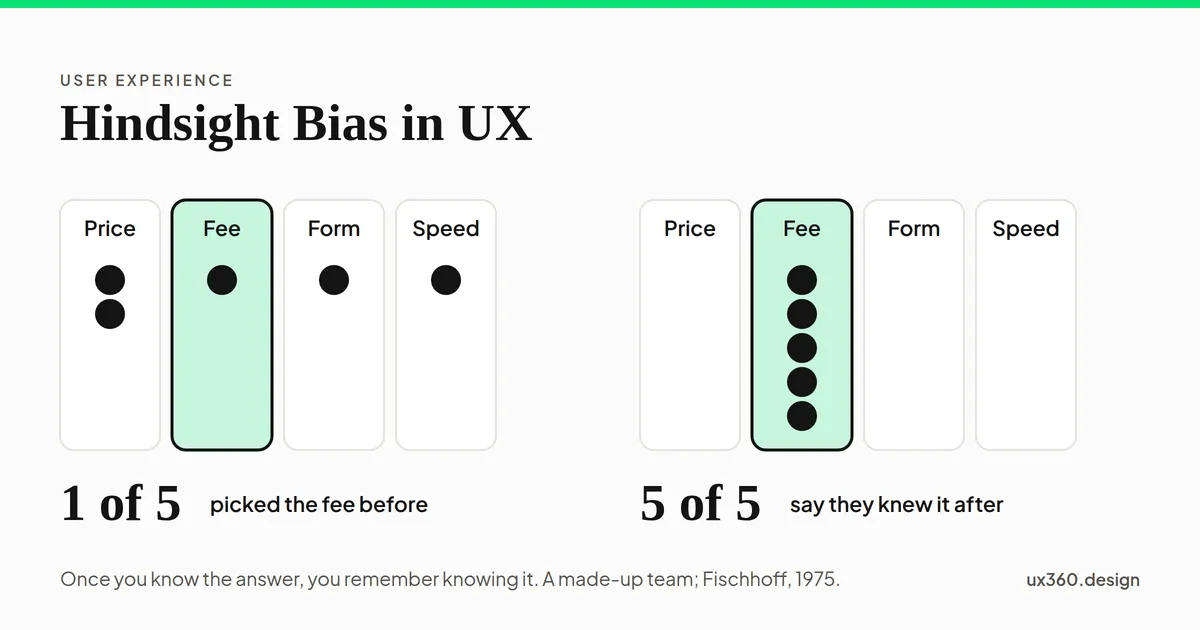
A team of five guesses why customers leave checkout. Then the research says it was the surprise delivery fee. Ask the team at three moments.
Before the readout, nobody knows the answer. The five guesses are spread out: 2 on price, 1 on delivery fee, 1 on sign-up form and 1 on slow page.
Before the readout, the guesses are spread out. After it, from memory, everyone knew. The poll is the only thing that shows what the research actually taught the team.
Where it hides
- Research readouts. “We knew that already” is often hindsight. It can make good research look like a waste of money.
- Post-mortems. After a launch fails, the warning signs look obvious. At the time, they were mixed in with signs that pointed the other way.
- Design reviews of old work. A past design looks naive once you know how users reacted. It was a reasonable bet with what the team knew then.
- Your own predictions. You remember being right more often than you were, so you trust your gut more than you should.
How to beat it
You cannot stop knowing the answer, so you need a record of what you thought before you knew it.
- Write your guess down first. Before any test, note what you expect and how sure you are.
- Poll the team before the readout. Ask each person to pick an answer. Keep the poll.
- Show the poll next to the finding. People can see what surprised them, and so can you.
- Name what would prove you wrong. “We’d be wrong if fewer than half finish setup.” Then the result has something to check against.
- Keep a decision journal. Note what you decided, what you expected and why. Read it when the result comes in.
- Judge the bet, not the outcome. Ask whether a decision was sensible with what the team knew at the time.
One warning. Imagining other endings can help, but only a few. In a 2002 study by Lawrence Sanna and colleagues, people who listed two ways an event could have gone differently showed less hindsight bias. People asked to list ten found it hard, and showed more. Running out of ideas made the real ending feel even more certain.
Try it yourself: write it down first
Here are three made-up A/B tests. Each result has a believable story either way. Note a guess for each test, then show the results.
No guesses noted yet, and the results are hidden. Pick a guess for each test first.
Whichever way each test went, there was a story ready. Asking for a card scares people off, or it brings in only the serious ones. Five plans confuse people, or they help people find their fit. “Start free trial” says what happens, or “Get started” asks for less. Without your note, the winning story would have felt like the one you believed.
Hindsight bias and other biases
- It protects confirmation bias. If every result feels expected, you never notice that you were wrong.
- It is the time-travel cousin of the curse of knowledge. There you cannot imagine not knowing something. Here you cannot remember not knowing it.
- It hides survivorship bias in post-mortems: you explain the result with the clues you can still see.
- Usability testing is the best place to practise. Write down where you expect people to get stuck, then watch.
See the map of cognitive biases for how these fit together.
Common mistakes
- “We knew that already.” Maybe. Without a written guess, nobody can tell.
- Judging people by outcomes. A good decision can turn out badly. Judge what they knew at the time.
- Listing every possible ending. A few alternatives help. Trying to list many can backfire.
- Thinking a warning is enough. Knowing about the bias does not make it go away. A written record does.
Frequently asked questions
What is hindsight bias?
Hindsight bias is the feeling, after you learn how something turned out, that you knew it all along. Once you know the answer, it is hard to remember not knowing it.
Why is hindsight bias a problem in UX?
It makes research findings feel obvious. A team that thinks it already knew the answer decides the research was a waste, and stops testing ideas before it builds them.
How do you avoid hindsight bias in user research?
Write down what you and your team expect before the research starts. Show those guesses next to the findings. Do not rely on memory, because memory moves toward the answer.
What is the difference between hindsight bias and confirmation bias?
Confirmation bias works before the result: you look for evidence that agrees with you. Hindsight bias works after it: you remember having expected whatever happened.
Practise this in the free course: lesson 4.5 covers writing down what would prove you wrong before the results come in. Open lesson 4.5, or see every bias sorted by who has it.
The UX Foundation Course, free
Become the person in the room who understands the user when everyone else is guessing. 4 chapters, 27 free lessons, no sign-up.

Written by