
Curse of Knowledge in UX Design: Why Experts Build Things Beginners Cannot Use
The curse of knowledge is the trouble we have imagining what it is like not to know something we already know. In UX it makes designers use labels, steps and shortcuts that feel obvious to them and confuse newcomers. The fix is to watch real beginners and to write in the words they use.
What is the curse of knowledge? The curse of knowledge is the difficulty of imagining what it is like not to know something you already know.
Once you understand something, you cannot easily go back to not understanding it. A label, a step or an icon feels obvious. You forget that you once had to learn it.
In short
- What it is: a bias where people who know a thing cannot picture what it is like not to know it.
- Why it matters: the people who build a product know it best, so they are the worst judges of whether it is clear.
- How it shows up: team words as labels, icons with no text, onboarding that skips the first step, error messages written for engineers.
- The fix: watch real beginners, use the words they use, and explain the first step.
Why does it happen?
There are three reasons.
- Knowledge fills the gaps. When you read a label you already understand, your mind adds the meaning at once. You do not notice that you did it.
- You say the words every day. Words your team shares start to feel like plain English. They are not.
- Your memory of being new fades. You can remember that learning was hard. You cannot remember what it felt like, or which parts were hard.
Imagine you give directions in your own town. You say, “Turn left at the old bakery.” The bakery closed years ago, but you can still see it. A visitor sees a plain wall and drives past.
What the research shows
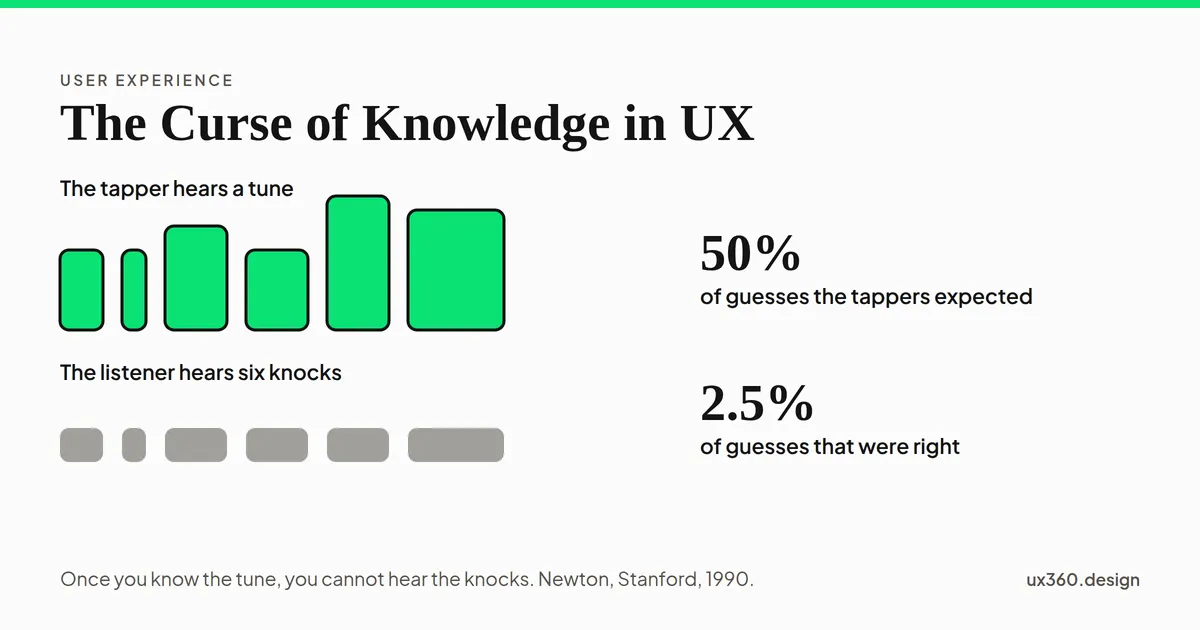
The tapping study. In 1990, Elizabeth Newton, then a graduate student at Stanford, asked people to tap the rhythm of a well-known song, such as “Happy Birthday”, on a table. Other people had to guess the song. The tappers thought the listeners would guess right about half the time. The listeners guessed right about 2.5% of the time, which is roughly 1 song in 40. The tapper hears the whole song in their head. The listener hears only taps.
Experts guess badly about beginners. In 1999, Pamela Hinds asked people with different amounts of experience to guess how long a beginner would need to learn a new mobile phone. The more experienced the guesser, the more they underestimated.
Three economists, Colin Camerer, George Loewenstein and Martin Weber, gave it the name “curse of knowledge” in 1989.
Hear the tapping
Try both roles. As the tapper you hear the tune. As the listener you hear what the table gets.
You are the tapper. In your head the six taps are a tune: G, G, A, G, C, B, each note a different pitch. You are sure it is obvious, and in the study tappers expected about half of listeners to name the song.
The tapper and the listener are in the same room, and they hear very different things. Your users are in the same position. You hear the whole product. They hear the taps.
See it in an interface
Here is a small app screen with five labels. The made-up numbers are only there to show the shape of the effect. Slide how long you have worked on this product, then switch the words between the team’s words and plain words.
With the team’s words and 0 months on the product, you understand 2 of 5 labels and a new user understands 2 of 5. You are as new as a new user here, so you see the same question marks they do.
Slide to 12 months with the team’s words. You now understand all five labels. A new user understands two. And you can no longer see the problem, because every label looks fine to you. That is the curse.
Now switch to plain words. The new user understands all five, and it did not matter how long you had worked on the product.
Where it hides
- Labels and menus. Words from your code, your database or your meetings.
- Icons with no text. An icon is a word in a language you had to learn.
- Skipped steps. The setup guide starts at step three because you finished steps one and two years ago.
- Error messages. “Conflict on resource 409” means something to the team and nothing to the person who lost their work.
- Empty screens. The screen is clear if you know what normally goes here.
How to beat it
You cannot un-know what you know, so imagining a beginner does not work. You have to check.
- Watch real beginners. Give five people a task and stay quiet. Write down where they stop.
- Use their words. Take labels from support questions, search terms and interview quotes.
- Explain the first step. Write onboarding for a person who knows nothing about the product.
- Ask an outsider to read it. Someone from another team reads the screen before it ships.
- Write errors in two parts. Say what happened, then say what to do next, in plain words.
- Keep a list of team words. Keep them out of the interface, or explain each one the first time it appears.
Try it yourself: translate for a newcomer
Here is a screen written entirely in the team’s words. Pick the words for each label. Then see how many a new user would understand.
0 of the 4 labels are in plain words. 4 still use team words, which say their meaning only to the team.
Plain words say what will happen. Vague words say nothing. Team words say it only to the team. A good label tells a stranger what happens when they press it.
The curse of knowledge and other biases
- It is the knowledge version of the false consensus effect. With false consensus you assume others want what you want. With the curse of knowledge you assume they know what you know.
- It feeds confirmation bias: a team that finds its own screen clear tends to find evidence that it is clear.
- It is why recognition over recall matters. A visible, plain label asks less of a beginner than a menu they must remember.
- The best cure is usability testing, because it lets you watch a beginner instead of guessing.
See the map of cognitive biases for how these fit together.
Common mistakes
- “I explained it clearly.” Clearly to you. You are the one person who cannot judge.
- Testing with colleagues. They share your words.
- Fixing only the words. If a step is missing, a better label will not help.
- Calling the beginner slow. They are not slow. They are new.
Frequently asked questions
What is the curse of knowledge?
The curse of knowledge is the difficulty of imagining what it is like not to know something you already know. Once you understand a thing, it is hard to see it the way a beginner does.
Why is the curse of knowledge a problem in UX?
The people who build a product know it best, so they are the worst judges of whether it is clear. Labels, steps and icons feel obvious to the team and confuse new users.
How do you avoid the curse of knowledge in design?
Watch real beginners use the product, write labels in the words they use, explain the first step, and ask someone outside the team to read the screen before it ships.
What is the difference between the curse of knowledge and the false consensus effect?
The false consensus effect is assuming other people think and want what you do. The curse of knowledge is assuming they know what you know. The two often appear together.
Practise this in the free course: lesson 3 covers testing whether users understand what you take for granted. Open lesson 3, or see every bias sorted by who has it.
From UI to UX: a free one-week course
Become the person in the room who understands the user when everyone else is guessing. Six free lessons, no sign-up.

Written by