
Hick's Law in UX: Why More Choices Take Longer
Hick's law says the time it takes to choose grows with the number of options, in step with the logarithm of that number, so doubling the options adds only a little time. It holds when people know the options. When they have to read an unfamiliar list, time grows much faster. In UX it favors broad, ordered menus over deep ones.
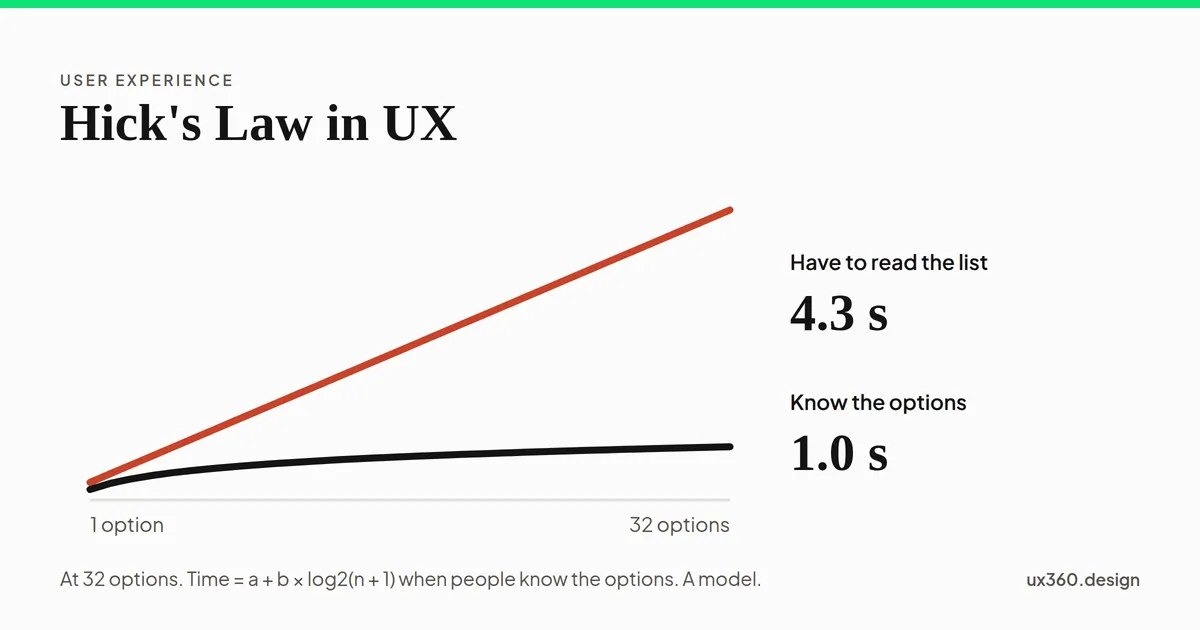
What is Hick’s law? Hick’s law says the time it takes to choose grows with the number of options, but slowly: it grows with the logarithm of the number, so each doubling adds about the same small amount of time.
It is often quoted as “fewer options means faster decisions”. That is true, but only part of the story. The law has a precise shape and clear limits, and the limits matter more for design than the headline.
In short
- What it is: a law of choice time. Going from 2 options to 4 adds about as much time as going from 16 to 32.
- Who found it: William Hick in 1952 and Ray Hyman in 1953, so it is also called the Hick-Hyman law.
- Where it holds: when people know the options and just have to pick one.
- Where it breaks: when people have to read an unfamiliar list. Then time grows much faster.
The formula
Hick sat people in front of a row of lamps, each with a key. A lamp lit up and they pressed its key as fast as they could. He changed the number of lamps from one to ten. Reaction time did not grow in a straight line. It grew with the logarithm of the number of choices.
time = a + b × log2(n + 1)
- n is the number of equally likely options. The +1 is often read as the extra choice of whether to respond at all.
- a and b are constants measured for each task and person.
Hyman went further in 1953. He made some lamps light up more often than others. Time followed the information in the choice, in bits, not just the count. An option people expect is quicker to pick than one they do not.
The law, and where it breaks
Slide the number of options. The green line is Hick’s law, for options people know. The coral line is a simple model of a list people have to read, one item at a time, until they find theirs.
8 options. If people know the options, Hick's law predicts about 675 ms to choose. If they have to read the list to find their option, the reading model predicts about 1325 ms, 2.0 times as long.
With 8 known options the choice is quick, and going to 16 adds little. With 8 options people have to read, it already takes longer, and it gets worse in a straight line. Most real menus sit somewhere between the two: people know some items and scan for others.
This is the part quotes of Hick’s law usually skip. The log shape needs people to know where things are. A long, unfamiliar list is slow for a different reason: people have to read it.
Broad menus beat deep ones
If each choice has a fixed cost, splitting a menu into levels means paying that cost again at every level. Here are the same 64 items arranged four ways.
All 64 items sit in one level, so it takes one choice among 64. The model predicts about 1.1 s in total, the fastest of the four, because the fixed cost of a choice is paid once.
One broad level of 64 is the quickest in this model, and six levels of two is the slowest by far. This matches a classic study: in 1985, Thomas Landauer and D. W. Nachbar timed people choosing from menu trees on a touch screen, and broader, shallower menus were faster.
There is a catch. Broad only wins if people can find things in it. A list of 64 in a sensible order works. A jumble of 64 does not.
How to use Hick’s law
- Order lists the way people think. Alphabetical, by date, by frequency. A predictable order turns reading into picking.
- Prefer broad and shallow. Show more items at one level rather than hiding them behind extra clicks.
- Group long lists with clear headings. Headings let people skip whole groups instead of reading every item.
- Highlight the likely choice. A sensible default or a “most popular” label makes one option expected, which Hyman showed is faster.
- Hide only what is truly rare. Moving rare options to an “Advanced” section shortens the list most people see.
- Do not cut useful options to look simple. A missing option costs more than a slightly longer menu.
Try it yourself: design a menu
Pick the size of a menu, how many levels it has, and whether people know where things are. The bar shows the model’s total time.
32 items in one level, and people know where things are. That is 1 choice, about 1.0 s in total. With known items, fewer levels win: every level adds a fixed cost.
With known items, fewer levels win every time. With a list people have to read, splitting it into levels can help, because each level is short enough to scan. The best menu depends on what your users already know, which is something only research can tell you.
Hick’s law and other principles
- It pairs with Fitts’s law. Hick’s law is the time to decide, Fitts’s law the time to reach. A menu pays both.
- It is related to choice overload, but they are not the same. Hick’s law is about seconds. Choice overload is about whether people choose at all, and its evidence is mixed.
- Chunking and recognition over recall are why grouped, visible options are easier than long hidden ones.
- The default effect shows the other side of a highlighted choice: people often keep it.
See all the laws of UX, in the order a click happens.
Common mistakes
- “Fewer options is always better.” Cutting a needed option forces a search somewhere else.
- Hiding everything in submenus. Each level adds a choice. Deep menus are slow.
- Ignoring order. A broad menu in random order is just a long list to read.
- Quoting it for complex decisions. Hick’s law describes quick picks, like a menu item. Choosing a phone plan is a different kind of decision.
Frequently asked questions
What is Hick's law?
Hick's law, also called the Hick-Hyman law, says the time it takes to make a choice grows with the number of options. It grows with the logarithm of the number, so each doubling adds about the same small amount of time.
What is the Hick's law formula?
Time = a + b × log2(n + 1), where n is the number of equally likely options. The constants a and b are measured for each task and person.
Does Hick's law mean fewer options are always better?
No. It applies to choices where people already know the options. It says nothing about whether an option is useful, and splitting a menu into many levels can make it slower, because every level is a new choice.
What is the difference between Hick's law and Fitts's law?
Hick's law is about deciding what to pick. Fitts's law is about the movement to reach it once you have decided. A menu has both costs.

Written by